
WonderCon 2025 Interview: Artist Randal “R.K.” Milholland
“It’s nice to know if I fail, I won’t fail alone.”
“Jesus, try to find the bright side, Rory.”
“The ‘bright side’ happens when everything goes down in flames.”
– Something*Positive, April 11, 2025
Something*Positive is a ‘day in the life’ webcomic that follows the main character of Davin MacIntire and his group of friends. Started in 2001, it is loosely based on the life and friends of creator Randal “R.K.” Milholland, and is darkly funny, skewering everyone and everything it can. It is sweet and sad and preposterous and honest: sometimes all at once.
I’ve been wanting to interview Milholland for a while–since at least 2013–and when I saw he was going to be at WonderCon, I jumped at the chance.
Milholland originally only planned on the comic ending after ten years. That deadline, of course, has long passed, and so one of the first things I asked was whether he thought he’d still be doing the comic in 2025. “I just like doing it, and I still have ideas, so I’m going to keep doing it until I run out of them,” he said with a smile.
I’ve been a fan for a long time, relating far too much to it. The comic (especially in the early days) had a lot of nods to community theatre. As someone who has spent a considerable amount of time in community theatre myself, that was what brought me to the comic in the first place. I had to jokingly ask how he was able to crawl into my brain. “I think all theater people: we share the same brain,” he agreed with a laugh. “It’s like orange cats. There’s one brain between us. One person gets to have it. They’re usually stage managing. No one else gets to have it while they have it.”
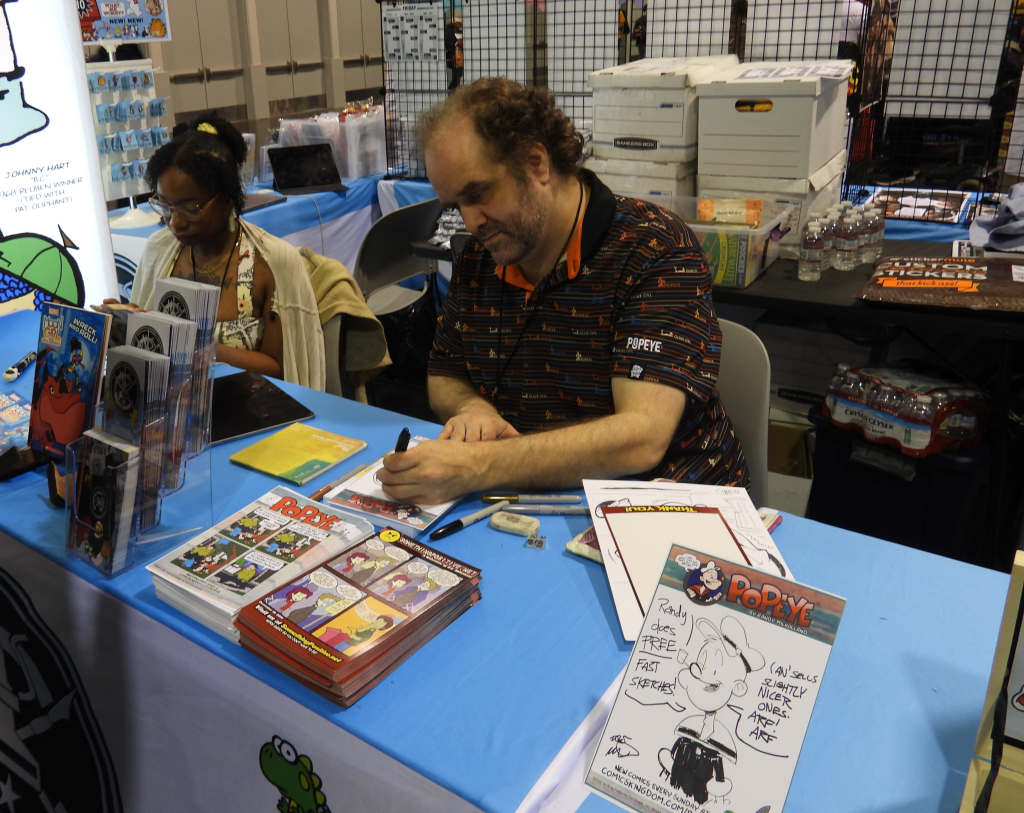
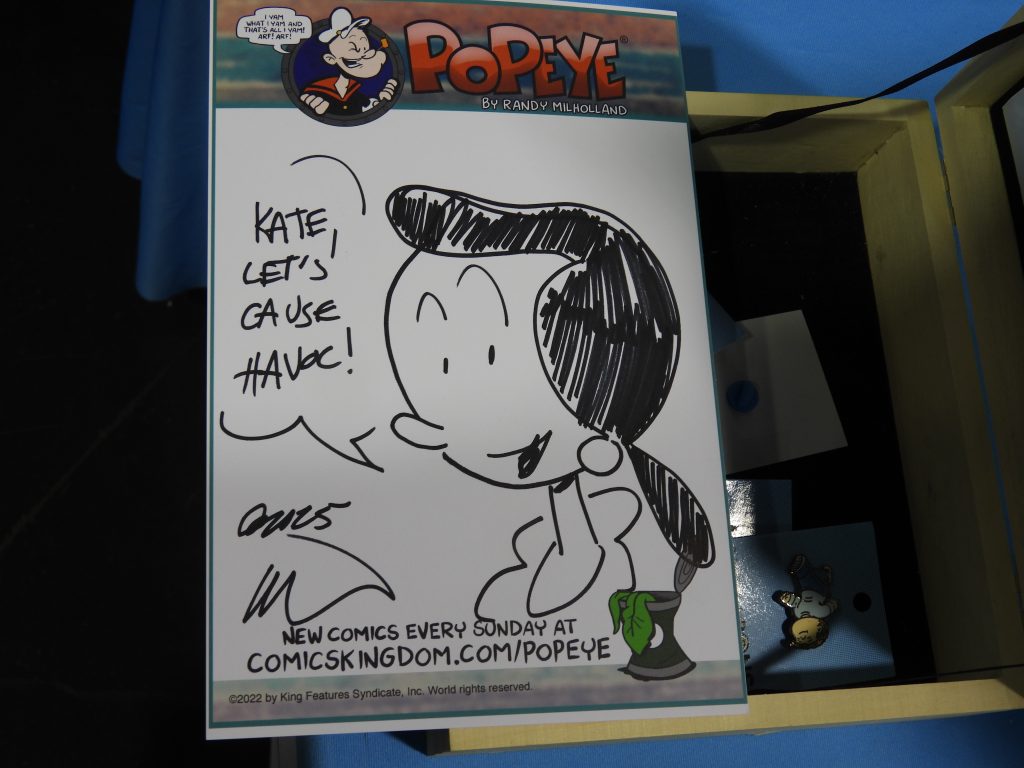
Milholland is a geek just as much as I am. In 2022, he was hired to do the Sunday comic strips for Popeye, which he’s been a fan of for most of his life. I asked him (as he wore a shirt with the character on it) how that came about. “They had an anniversary event in 2018/2019, and I did a strip for that,” Milholland said. “I actually did six strips: they chose one. It was very well received. They said it was the most-viewed comic on the Comics Kingdom site for the year. I wanted to take over the daily strip, because that’s been rerun since 1992. They asked if they could run the package on the website. Again, it was heavy traffic. But the strips are not in enough papers. And so they shortlisted me for when Hy Eisman decided to retire because he was doing the Sunday strip. So basically, when he decided he was ready to retire, they had someone to step in. And when he said, ‘You know what? I think I’m done,’ they called me up.”
Since Something*Positive is his own creation and Popeye is owned by someone else, I asked how much control he has over what he draws for the strip. “A surprising amount,” he said. “It’s rare that they tell me no. In fact, I can think of twice they’ve ever told me no. One was like, ‘Hey, this is too similar. It’s a parody of another property, but we can get in trouble because Viacom owns it.’ And then another time, it was like, ‘We just had some concerns.’ I was like, ‘No, the punchline is not worth it.’ But overall, as long as I can explain to them the reason why I want to do something… Like when I wanted to make Bluto and Brutus separate people, I was able to defend it with Hy Eisman did it technically. Here’s all the other comics that show them as different people.’ As long as I can explain why it’s important for a storyline, they generally go, ‘Okay, do it.’ And some things I just do. They trust me enough that I have a lot of freedom.”
When Milholland started Something*Positive, you still had to explain what a webcomic was. Nowadays, of course, they are everywhere. I asked him what it was like doing it in 2025 versus back then. “Probably not as profitable,” he said with a grimace, “but at the same time freedom. I mean, I still make a living, which is nice. It’s different: like ad revenue, obviously, is not what it was. Merch is a lot different. The audience is different as well. And I have a situation where my audience is growing older, so I had to also reach younger people. Which, thankfully, I’ve been able to do. The main thing is making sure you’re not repeating yourself. I have the fortune that my characters age in real time, so I can bring in younger characters as well. Therefore, I can touch on things like young queer characters realizing that they’re queer and having new identities and maybe finding safer places to live.”
I followed up on that line of conversation, talking about the motivation behind this inclusion. “I think it’s just one situation where I have not always been the best at,” Milholland said. “I can own it. But as I begin to understand myself better, people in my life, you know—all my friends have come out as trans or nonbinary and seeing that. Also, just meeting younger people. I have developed friendships with people who are younger than me. They have the words that most of my older friends didn’t have to understand who they were, and wanting to show that, show like, ‘hey, sometimes this is generational.’ As things are changing in our landscape, in a lot of ways for the worst, because I’m from Texas… I mean, there’s a reason my family moved from Texas [to California]: to get away from a lot of that. At one time, I wouldn’t have addressed that in my comic. But now, I feel like I have no choice. I have to, because, you know what? People who live this don’t have a choice but to address it either. So why not bring it in?”
Another way I relate to the comic is that Milholland is very public about his mental health and how it affects his life. I asked him what made him decide to disclose this in his comics and on social media. “A therapist told me to start talking about it, because if I were to start talking about it, it would be real,” Milholland said. “And I couldn’t pretend it wasn’t happening. I had to accept it. And honestly, sometimes, I’m behind: I feel like I owe readers, which I don’t technically. I know I don’t owe my readers explanations, but sometimes you’re just like, ‘You know: I’m having a bad brain day. I don’t know what to do,” or ‘I hate myself, and I know it’s stupid.’ And I’m realizing a lot of men my age, cis men, were taught not to do that.
“I have friends [where] that is a struggle for them now, where they’re just now talking about things that traumatized them then when they were younger, and when they tried to talk about it when they were in their 20s to people, they were told to shut up. And I want people to see that that’s okay, because I didn’t have anyone telling me that was okay. And maybe it will prevent someone from imploding, maybe [keep] someone from having a total breakdown. Men’s mental health is usually only brought up as a shutdown argument, of like, ‘Well, we don’t talk about this.’ Men need to address their mental health, yeah, but we don’t know how. We’re not taught how. I remember talking when I was much younger about being sexually assaulted and being told no one wants to hear this from a man, so you need to be kind of quiet about it. Or the jokes of, ‘Aren’t you so lucky?’ And it’s a thing that I think needs to be addressed, because it also affects the people in our lives who depend on us, who are around us. It affects their mental health as well, and not addressing it has probably caused a lot of problems.”
Another aspect that I connected with was when Milholland decided to have the main character’s father diagnosed with (and eventually die from complications of) Alzheimer’s. A good friend of mine had lost her own battle several years ago (who was a theatre teacher to boot), and while it was a hard plotline to get through, it also made me feel not alone in my grief. “That plot line hurt a lot of people,” he agreed. “I had at least a few readers who said, ‘I will come back when Fred’s gone. I can’t handle this right now,’ which is fair. I will always tell them, ‘Don’t. If it’s causing you pain, step away. There’s nothing wrong with that.’ I don’t want a comic to hurt someone, but at the same time, I gotta talk about what I talk about, and I think that it’s good sometimes. If your comment’s, ‘You’re touching on issues I can’t deal with right now. I’ll be back for the next storyline,’ that’s valid.”
Milholland occasionally makes comics that address his creative process and the problems he sometimes has. So, as I like to do when I talk to creative people, I asked him what he does to keep from being burned out. “I think it’s because the character [of Popeye] is so important to me from my childhood,” he said. “I’ve always loved the comics. And there’s over 100 years of comics I can mine—bring back characters, including characters people don’t know existed. There’s 30-40 years that have never been reprinted ever, and I have access to that. I’m like, ‘Well, this character is fun. This is never addressed. Bring them back. Let’s reintroduce them to everybody,’ like Popeye’s mom, Popeye’s aunt. And honestly, sometimes I’m having trouble with this character, switch to a different character, find another character, have a storyline.”
I know well enough not to ask where story ideas come from, but I was curious if he typically had a concept of dialogue first and then he drew, or the other way around. “Usually, I know what I’m going to do, and I can sit down and I’ll write the script up,” he said. “But every once while, there’s some strips where I don’t know what to do with this. And sometimes, I’ve done what I called pantomime strips. Literally, I’m just drawing it. I like this better with no word bubbles, and that’s how it ends up being the way it is.”
I asked why he still does it in 2025. “Because you need to,” he said matter-of-factly. “You’re going to do it anyway, why not try to get paid for it? I mean, most of us will be drawing no matter what. This is just what we do. And a lot of us have a need to tell a story. We need to put art out there. We want to talk. We want to present things. So why not? And, you know, I like it, and it has given me a lot of freedom in ways I didn’t expect.”
Something*Positive is updated on an ‘as-he-can’ schedule, and the site itself is currently going through a redesign, but can be found here. You can see his Popeye strips over at Comics Kingdom here. See all my WonderCon 2025 coverage here.

Author: Angie Fiedler Sutton
Angie Fiedler Sutton is a writer, podcaster, and all-round fangirl geek. She has been published in Den of Geek, Stage Directions, LA Weekly, The Mary Sue, and others.
She also produces her own podcast, Contents May Vary, where she interviews geeky people about geeky things. You can see all her work (and social media channels) at angiefsutton.com.
Help support independent journalism. Subscribe to our Patreon.
Copyright © The Geekiary
Do not copy our content in whole to other websites. If you are reading this anywhere besides TheGeekiary.com, it has been stolen.Read our
Related posts:
WonderCon 2025 Interview: Ashley Maria of 'Super Human Anxiety'

WonderCon 2025 Interview: Legion M’s "Fade to Black"
WonderCon 2025: Funko, Loungefly, and Mondo Booth Tour
WonderCon 2025 Interview: Composer Ian Arber
WonderCon 2025 Interview: Composer/Music Producer Aaron Gilhuis
WonderCon 2025 Interview: Andy Nordvall, Kaj Kunstmann, and Bad Future Vol. 1