
The Magic of Storytelling – “100 Nights of Hero” Review
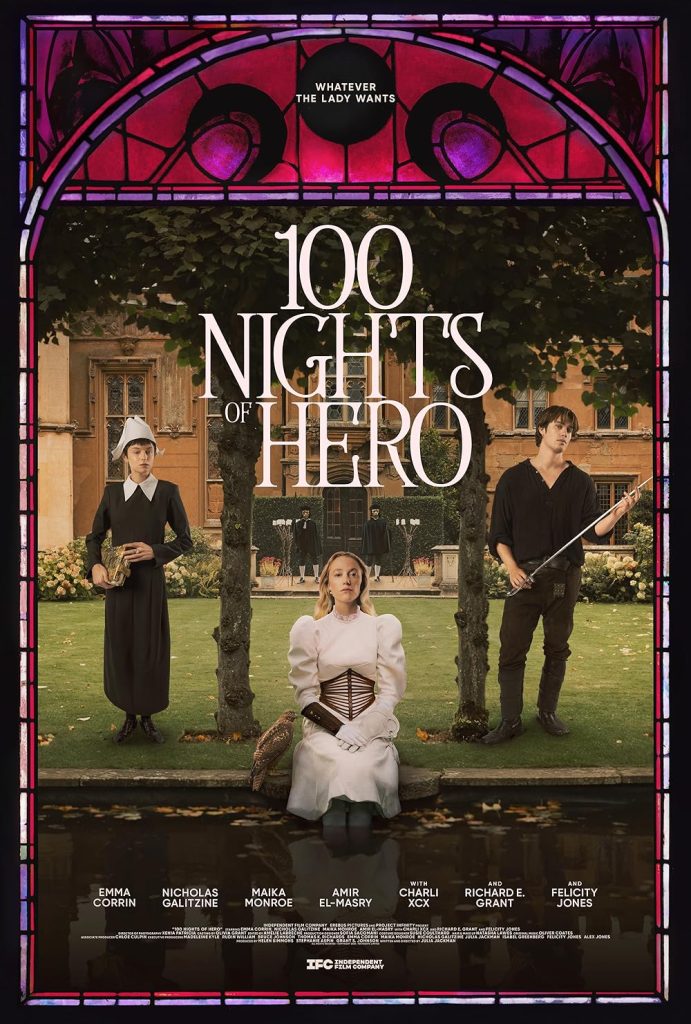
Fairy tales often have a lesson or a moral that readers are meant to take away. A lot of traditional fairy tales warn children to be cautious, skeptical, and aware. 100 Nights of Hero is a modern-day fairy tale that at once feels very foreign and very topical.
100 Nights of Hero is the live-action adaptation of the graphic novel The 100 Nights of Hero by Isabel Greenberg, which is in itself a reimagining of One Thousand and One Nights. It tells the story of Cherry (Maika Monroe), whose disinterested husband Jerome (Amir El-Masry) leaves her alone for one hundred nights in the “care” of his friend Manfred (Nicholas Galitzine) to test her fidelity. Cherry’s only companion is her maid, Hero (Emma Corrin).
The Wikipedia entry describes what happens as a love triangle between Cherry, Hero, and Manfred, but I find that to be a bit of a shallow take on the actual relationship dynamics in this film. A woman created the world in which these characters live, and then a man took over and made it “perfect” (aka a thousand times worse, at least for the women). In this world, a woman’s only worth is to provide children, and women who are infertile, or educated, or anything less than perfectly docile, obedient incubators are put to death.
It feels a little too real, considering everything going on in the world right now. Namely, a bunch of men making decisions about a woman’s future, even what happens with her own body.
This is, however, a core component of the underlying tension in 100 Nights of Hero, because after six months of marriage Cherry is still not pregnant, which is naturally considered to be her fault, and the council has given her a hundred days to become so, or she will be executed. Jerome uses Manfred’s opportune arrival as a chance to procure an heir by conveniently leaving on “business” for the entire one hundred days.
Therefore, what Cherry is experiencing is less an attraction to Manfred and more a desperation to not be killed. She never really exhibits any sort of feelings for the interloper in her home, despite his repeated and brazen attempts at seduction. She does, however, have a significant amount of sexual tension with the loyal Hero, who assists Cherry by starting to tell a story whenever Manfred starts getting too full of himself.
100 Nights of Hero is, at its core, about women wanting more for themselves. The world depicted treats women as nothing more than vessels for childbearing. Women are not permitted to be taught to read or write. And even the hobbies that Cherry has – chess, falconry – are typically considered to be more male-oriented. (Although I do love that she excels at both, especially because Manfred had previously expressed that his ideal woman must be interested in those pastimes but not be better at them than him.)
It is also, as my title suggests, about the magic of storytelling. Not just literal magic – which is implied in the way time passes differently when Hero is talking – but also the real “magic” that a good story can do. A good story can humanize, empathize, empower, enrapture. A good story has the potential to change the world. And while 100 Nights of Hero may not usher in a revolution, I do think it’s a good message, and it’s one that’s emphasized frequently: tell your stories.
Corrin, Monroe, and Galitzine give stellar performances. Monroe never lost the quiet desperation that must have plagued Cherry throughout. Corrin exuded a calm confidence but really plumbed Hero’s emotional depths when the situation called for it. And Galitzine was able to nicely balance charming, smarmy, and oafish.
Despite feeling very topical, the world also felt very foreign, primarily due to the costuming, which seemed to be mostly based on either medieval or Renaissance fashion. (I’m not familiar enough with the eras of fashion to definitively state which one was the greater influence.) But there are also the masks worn by the council of Birdmen (derived from Birdman, father of Kiddo, the creator of the world), as well as those worn by the guards in Jerome and Cherry’s castle. The guards’ masks in particular were a great metaphor for the breaking down of barriers.
The costume design, production design, and instrumental score all worked together to showcase a realm that was very fantastical while depicting a story that is all too real. Color, light, and empty space are used extremely effectively.
I really enjoyed this film. It’s charming, it’s romantic, and the cinematography is stunning. It’s definitely worth checking out when it releases, and make sure you stay until the very end of the credits!
100 Nights of Hero is directed by Julia Jackman and hits theaters in the US this Friday, December 5.

Author: Jamie Sugah
Jamie has a BA in English with a focus in creative writing from The Ohio State University. She self-published her first novel, The Perils of Long Hair on a Windy Day, which is available through Amazon. She is currently an archivist and lives in New York City with her demon ninja vampire cat. She covers television, books, movies, anime, and conventions in the NYC area.Help support independent journalism. Subscribe to our Patreon.
Copyright © The Geekiary
Do not copy our content in whole to other websites. If you are reading this anywhere besides TheGeekiary.com, it has been stolen.Read our
Related posts:

"Flashback" Director Chris MacBride Takes Us on a Deeper Dive

"Flashback" Director Chris MacBride Discusses His Forward Moving Influences

Review: ‘Masters of the Universe’ is Campy Fun

Win A Blu-Ray Copy of Dylan O'Brien and Maika Monroe in "Flashback"!
Teaser Trailer For Queer Film "100 Nights of Hero" Released

With Chris MacBride's "Flashback" the Choice is Yours - Movie Review