
LA Comic Con 2025: Sean Abley and the Appeal of Queer Horror
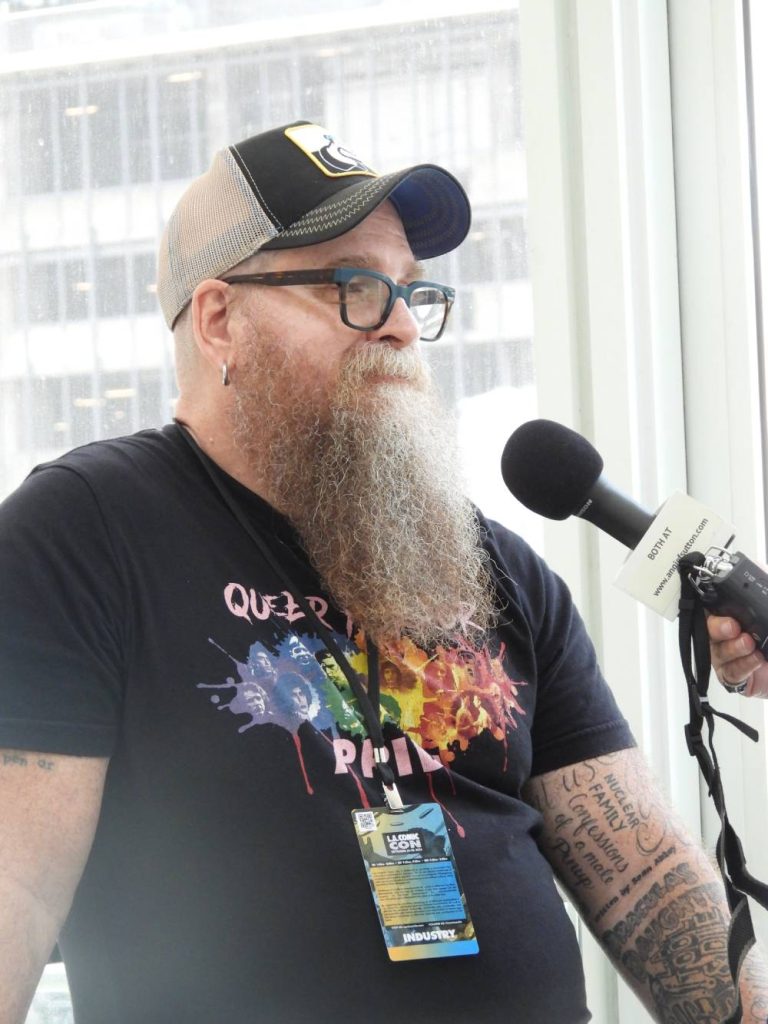
If you did a Venn diagram of the queer community and horror fans, there would be a major overlap—that’s not a new revelation. From James Whale to Ed Wood, horror films have had ‘queer coding’ to represent themes that resonate.
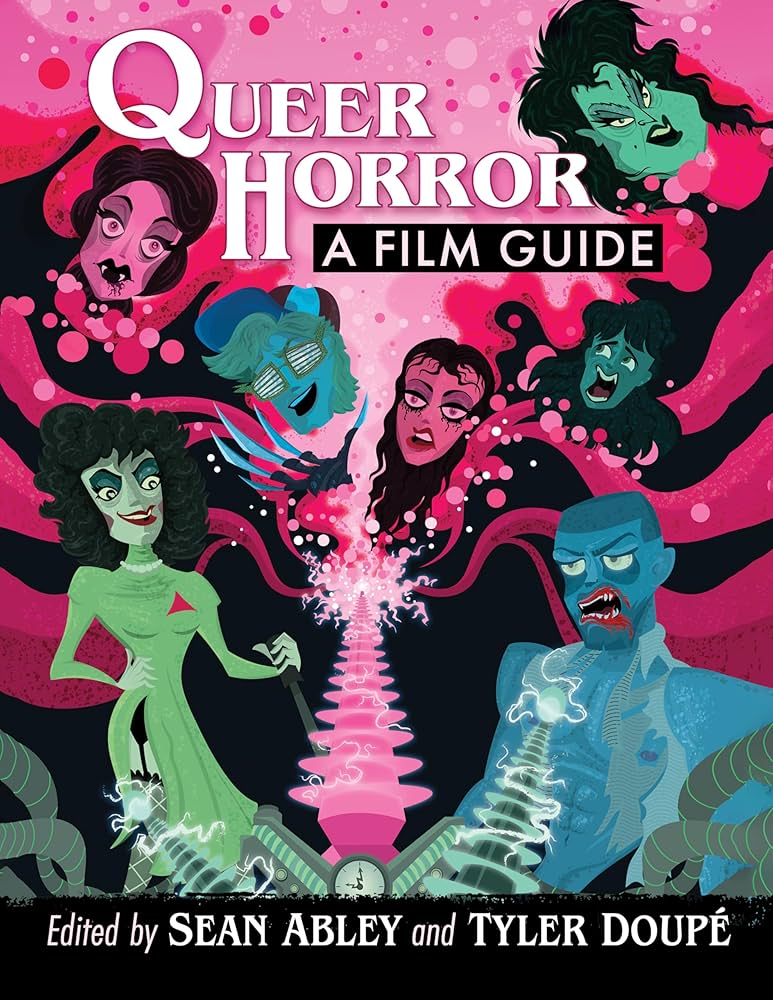
Sean Abley, co-editor of the book Queer Horror: A Film Guide and author of many an article and column for Fangoria, said, “There’s about three stock answers I think all of us fall back on when asked this question. For me as a young person, I was bullied, and then there was sort of free-floating trauma that just never ended with a horror film. You can live that trauma beginning, middle, and end, and it resolves. There’s that moment at the end where you have sort of this relaxed—I don’t know what you would call it—end to the cycle that you can enjoy; unlike in real life, possibly where it may not get better in the immediate.”
There are other reasons the community is drawn to the genre. “I think there’s also the revenge fantasy for a lot of queer people,” Abley continued. “Horror films are ordinary people in extraordinary circumstances who must become extraordinary themselves to live through the extraordinary circumstances. And I can’t think of a better description than queer people growing up in a hostile territory.”
I talked with Abley at LA Comic Con before the panel Queer Horror: A Film Guide – In Defense of Problematic Films he was moderating.
My first question, considering the title of the panel, was why he felt we should watch films that may be problematic. “For the most part, we were terribly represented for a long time,” he began. “But if we didn’t watch films where there’s terrible representation, we would watch almost zero films. So, what I and the panelists are doing is showing how we can enjoy these movies, even if not every part of the movie is a slam dunk for us. And that’s important, because to be disconnected from culture is to be disconnected from just what’s happening in the world right now, and so we owe it to ourselves to navigate these films, even if they aren’t necessarily, you know, 100% our philosophical bullseye.”
It’s no secret that The Hays Code led to the tropes that queer people are depraved villains who deserve to be punished. (And, no doubt, is still partially why we have the “Bury Your Gays” trope.) So I followed up asking if that meant the panel was looking at these films from a historical angle.
“I think we’re doing that, but we’re also giving permission to like films that maybe just don’t pass muster just because you enjoy them,” Abley said. “We’re giving you permission to not necessarily be offended by something that maybe somebody else is offended by. And we’re not trying to tell people that they should like every movie or that they should have to watch every movie, but what we’re doing is we’re modeling a film consumer behavior that allows you to enjoy those films without feeling bad about it if you want to.”
We also discussed the Hays Code and how that brought about queer coding in media, where a character (or plot) had traits that could be considered gay but was never explicit. “I think we need to reconcile ourselves with the fact that human beings back then understood what the subtext of the films were,” Abley said. “It wasn’t being snuck in and the general populace didn’t understand. They understood. For a long time, that was all we had. So, I won’t blame those films for doing that, but I think that today we’re at a point where subtext and coding are just a lazy way to present queer themes and characters and situations. If it’s done by queer filmmakers, I consider that absolute negligence. If it’s done by straight filmmakers, I consider that gay baiting.”
I brought up that the younger generation, when discovering some of the classics such as The Rocky Horror Picture Show, are not quite sure how to relate to the film under current mores. “I would never tell somebody that they’re wrong about a film,” Abley started. “What I would say about Rocky Horror is that that film opened the door for untold number of queer people to be who they are, to live their truth. And I can’t see that in a bad light. I think that the film is fun and funny, and it’s meant to be a little out there and edgy, but it’s also got a good heart and it represents queerness in a way that doesn’t adhere to a strict, pure palatable queerness. The film isn’t worried about offending you. In fact, the film on some level is trying to push your boundaries, and it certainly did back then. So, if you don’t like it, if it doesn’t add up today like it used to, that’s fine; but I would offer that receiving Rocky Horror Picture Show with an open heart and an eye toward the good that it’s done would benefit a naysayer.”
So, what are some of his favorite problematic films? “I have so many,” he said with a laugh. “Of course, there’s Cruising. There is High Tension. Some people don’t love the fact that it’s a lesbian killer and that she’s an unreliable narrator. Sleepaway Camp, of course, is a big favorite of mine. Salò [full name Salò, or the 120 Days of Sodom], which is an unending parade of just debauchery and depravity that I saw for the first time when I think I wasn’t ready to receive it for what it was, but I’ve since watched it with the more critical and forgiving eye, and it’s actually one of my favorite films.”
As a fellow geek journalist, I then transitioned to talking about his career. I brought up his interviews from his “Gay of the Dead” blog that he started for Fangoria. Focusing specifically on queer filmmakers working in the genre, it was the basis of Queer Horror: A Film Guide and also his new book (also called Gay of the Dead, which he also has a Patreon for).
I asked if he had a favorite interview or if there was someone he considered a ‘white whale’ that he managed to land. “I’ve talked to Dante Tomaselli, who does some of the best independent film work I’ve ever seen. Satan’s Playground is one that I really, really recommend of his. I’ve, of course, gotten to talk to Jeffrey Reddick. Don Mancini: I’ve become friends with him throughout that blog. Who else have I talked to? I talked to Bruce LaBruce, which is a fascinating, fascinating interview. He has such a depth of knowledge that I could barely keep up. Those are some of the highlights, but everybody has a really great story, and I am so happy that I get to sort of share that, help other queer people, especially young people know who’s who in our community working in horror.”
Of course, like all media, horror reflects the times it is made in. Things have really ramped up for the queer community with book bans, legislation against drag queens and trans people, and everyday violence rising. I asked Abley if he felt it was getting better or worse and where he saw it going. “I have to think that right now, we are in a very, very troubling, perilous time,” he said. “But if we can continue doing what we’re doing and what we are good at—which is surviving—I think that any defeats that we suffer right now are going to springboard us to an even better future. So, it’s just a matter of making sure we’re all taken care of.”
Whenever I meet a fellow fan, no matter what they are a fan of, I always want to know what about it drew them. What drew Abley to horror? “It’s funny: I’ve been asked that question a lot, and I actually think nothing drew me to horror,” he said. “It was just in my DNA. My mother was a big horror fan. My dad was a big science fiction fan. It was just in the house. They allowed me to watch any horror movie I wanted to from as young as I was. They would take me to the drive-in with them. So, I guess you could point to my parents, but honestly, I think the proclivity was just there.”
So, if someone wanted to get into queer horror (coded or un), what are his recommendations to get them started? “The Hunger, because it’s a big studio movie. It’s a lesbian-tinged movie, which there aren’t as many of sort of at your fingertips. It’s exquisite in a filmmaking sense. The performances are amazing, and it stars mainstream actresses who were not afraid to perform the material. I think it’s a really great example of what can be done at a studio level if people care to do it.”
And, of course, where would he recommend people go to find horror? Would he recommend the streaming service Shudder? “Sam Zimmerman [one of the channel curators of Shudder] was a boss of mine a million years ago when I was writing for a website. He’s a good guy and has a great eye. Tubi is actually a really great place to find horror: everything from the stuff made for $5 to the really big-budget stuff. I recommend it, although I do recommend that you make sure you’re getting the director’s cut of the film, because I believe Tubi has started doing what Blockbuster used to do, which is do their own cuts of the movie. So just make sure that you’re getting what you should be getting.”
You can find Sean Abley as ‘gay of the dead everywhere’, he said, including the Patreon where he’s rolling out Gay of the Dead: Conversations with LGBTQ Filmmakers Working in Horror. You can also find out more about him on his website.
See all my LA Comic Con 2025 coverage here, and see my highlight reel from the con on the Geekiary’s YouTube.

Author: Angie Fiedler Sutton
Angie Fiedler Sutton is a writer, podcaster, and all-round fangirl geek. She has been published in Den of Geek, Stage Directions, LA Weekly, The Mary Sue, and others. She also produces her own podcast, Contents May Vary, where she interviews geeky people about geeky things. You can see all her work (and social media channels) at angiefsutton.com.Help support independent journalism. Subscribe to our Patreon.
Copyright © The Geekiary
Do not copy our content in whole to other websites. If you are reading this anywhere besides TheGeekiary.com, it has been stolen.Read our
Related posts:
Midsummer Scream 2024 Interview: Zombie Joe of Zombie Joe's Underground Theatre
"Star Trek: Voyager" is Peak Sci-Fi Horror
Interview with 'HYSTERIA!' Writers Matthew Scott Kane and David A. Goodman

Midsummer Scream 2024: A Scary Good Time
LA Comic Con 2024 interview: Only Murders in the Building's Shelly Westerman and Payton Koch

"Love, Death & Robots" Review - A Very Interesting Sci-Fi/Supernatural Netflix Animated Show