
LA Comic Con 2025: Twenty-Sided Tavern Panel and David Carpenter – Interview
When the COVID lockdowns hit, the performing arts scrambled to figure out ways to keep their audiences engaged. Some did virtual shows, others did talks and panels with creatives, and some came up with inventive ways to do something new.
I talked to David Carpenter, the associate producer for Dede Harris Productions and an industry veteran for 20 years, who during that time worked on what would eventually be Dungeons & Dragons the Twenty-Sided Tavern.
“I had the software company, right?” he started. “I’ve been working on this software pre-pandemic on, trying to figure out how to do branching narrative style: you know, gamified stories on stage. And I spent about two and a half years working on a project that I could not get off the ground because I couldn’t figure out how to do it right. And the pandemic hit, and I moved everything online and I did 20 hour-long stories in 18 months.
We sold tickets to the public, and everybody watched on Zoom, and they played at home using my software, and did these live interactive Zoom theatre shows, right? That was the basis of what I’m doing now. And it was really just like testing out a bunch of ideas and figuring out stuff that worked. And one of the ideas was a D&D-style show, and it just popped from moment one.
Like there was just something about it where the interactivity, the gaming elements, all these various things worked really well online. And I thought, ‘Well, I think this is our entry point for stage.’ And so we started it back in September 2021 of the Philly Fringe Festival. And it was folding tables, box of props, right? Five people on stage. We really had no idea what we’re doing. The audience was using my software and it and it just was like magic. And I never look back.”
The Twenty-Sided Tavern is the first officially Hasbro-licensed theatrical endeavor in the Dungeons & Dragons universe. “Well, we’re not allowed to say first because we can’t actually prove it,” Carpenter said with a smile. “There might have been something else at some point in time, right? But we are the licensed live stage theatrical show in the world.”
I asked him who approached whom first? “We went to them,” he said. “So we were The 20-Sided Tavern. It started off as a total homebrew originally, and we always said that we were the D&D style-like stage experience. We were doing really well in Chicago in ‘22 and having a blast and the show was going really well. A friend of mine, who’s the CEO of a company called Path Entertainment in London, has a relationship with Hasbro because he does location-based experiences. He’d seen the show when we were at the Edinburgh Fringe Festival. He came to Chicago and he sat down and he said, ‘Do you want me to go to Hasbro and see if we could do a license deal?’ And I was like, ‘Yeah, I think we’re ready to do something like that.’ And we went to Hasbro, and Hasbro was like, ‘We’d love to. Let’s work out a deal.’ It was a long process, but then on the other side of it, we were then an official D&D show.”
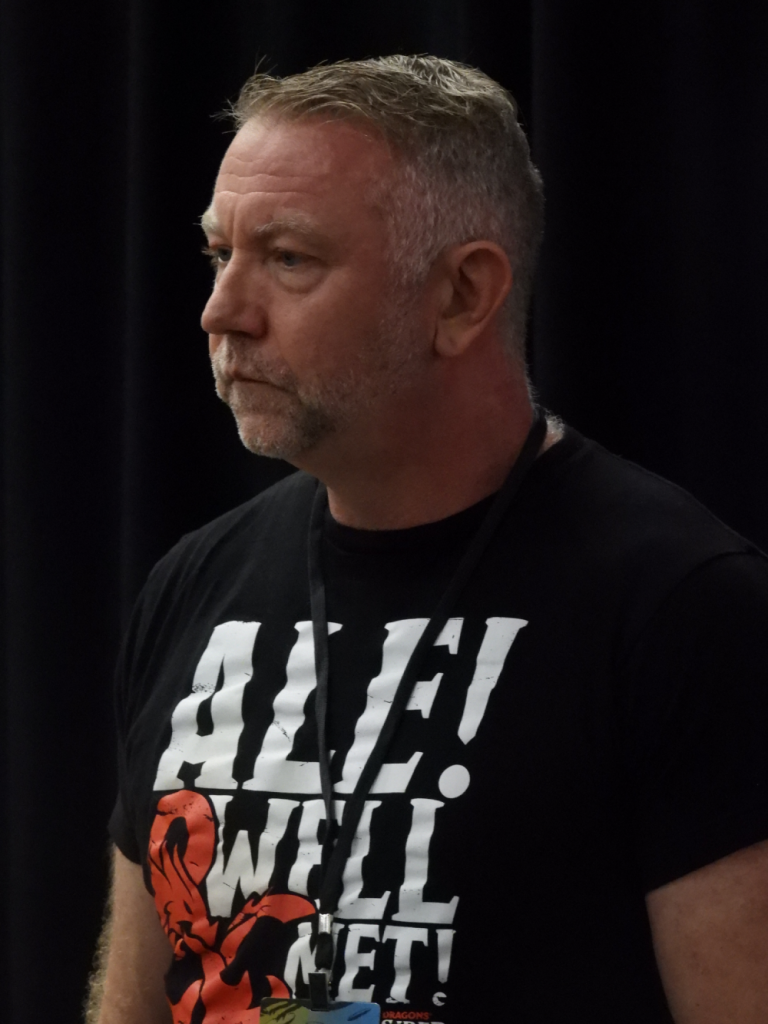
Since he used the term, we talked next about the concept of gamification. I still remember when the concept was new (I highly recommend Jane McGonigal’s book Reality is Broken, which was written at the time), and so I asked him his thoughts on why the concept has become so popular.
“I take the point of view that gaming has never not been popular,” Carpenter started. “I think what we’ve seen is a diversification in the types of games that people play. Like sports: sports entertainment is gaming entertainment, right? Gambling is gaming entertainment. What we’ve seen is the explosion of TTRPG. You’ve seen people get really invested in story. Certainly, board games continue to get more popular. Video games continue to get more popular. So, it’s just kind of a natural evolution that it has found its way into live entertainment. Like G4, which was huge for a while before it imploded: it was the start of saying, ‘Hey, people actually really like this as an entertainment option; not just something that they do at home, something they can do with their friends and go to with their friends. That isn’t necessarily like sports. And so I just think it’s a natural evolution of where culture is already going.”
Of course, when dealing with gamification—especially in live entertainment—there is always the possibility that something will go wrong. At the panel itself, there was a story about how one time the digital element didn’t work and so they had to improvise and use standard ‘hands up’ voting to make the decisions.
With that in mind, I asked Carpenter how he approached conquering the delay technology like phone voting inevitably has. “So the approach that I took from day one was to put the audience experience first,” he said. “As someone who’s worked on Broadway and off Broadway and worked in theatre in my entire life, I already knew what a good audience experience was and what the experience was of when you’re walking into a theatre to go see a show, right? So I took that, my own personal experience and knowledge, and I said, ‘If I needed to insert this idea that the audience would be using their phones in order to be able to interact with the show, what is the most seamless non-obstructionary way that I could do this? And that’s what led me to Dave Keane, who would design the software, and led me down this road of this web-based piece of software that is designed to be as fast and simple as possible. Because it’s a tool, right?”
He continued, “In everything that I’ve ever seen that has attempted to do stuff like this, when you have lag introduced, you take people out of the experience, and that’s not acceptable. So you have to have no lag, no matter what it takes. But also, like a lot of times from a design standpoint, it’s a gimmick, right? And it’s not actually furthering the story. It’s just this fun other thing that we do. Gameotics is a platform that I built this experience off of. And when you take a platform approach, which my contemporaries never really thought about it that way—that’s what changed it that’s what made it because it was like the platform has to work right, and it has to be easy, and it has to be the thing that helps tell the story and not a gimmick that’s just kind of sitting there in the way.”
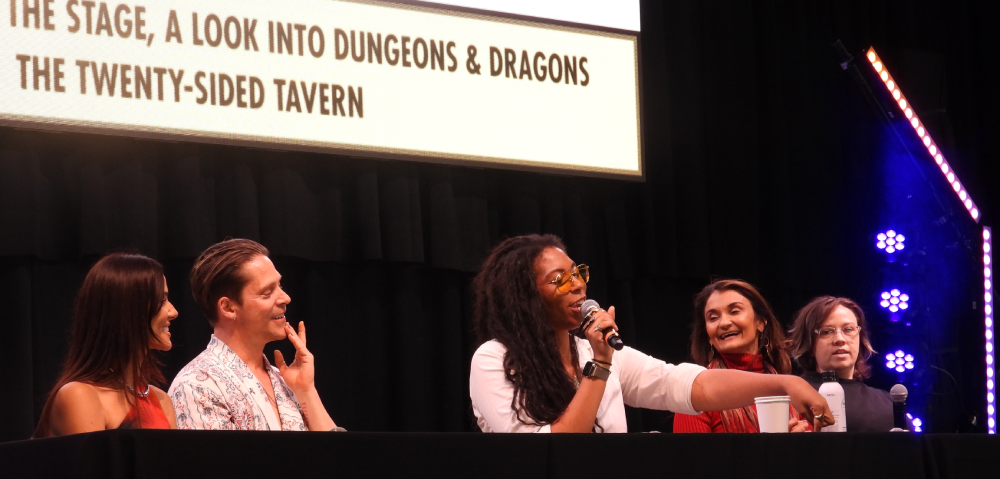
The panel itself (“From Licensing to the Stage, a look into Dungeons & Dragons the Twenty-Sided Tavern”) was David Carpenter moderating with panelists Aabria Iyengar, Anjali Bhimani, KC McGeorge, and surprise guests Neil Newbon and Devora Wilde.
The first question of the panel was Carpenter asking them to explain The Twenty-Sided Tavern for those who may be unaware of the premise. Bhimani started, stating, “The Twenty-Sided Tavern is a live improvised show that lives at the intersection of Dungeons & Dragons, improvised theatre, and mobile gaming, because there’s a beautiful platform that David created called that helps the audience be a part of the action and literally shape the story that we are going to tell on stage.”
Iyengar added, “It was all the fun of improvising collaborative storytelling, but the audience gets to be involved in a way that never really happens in other kinds of an actual play. You guys can watch it. We all get to sit and watch it on Twitch, but when you’re in the theatre, you’re a part of the story. You yell, you add things via the mobile app, and we all tell a story that will never exist again because it’s just us together.”
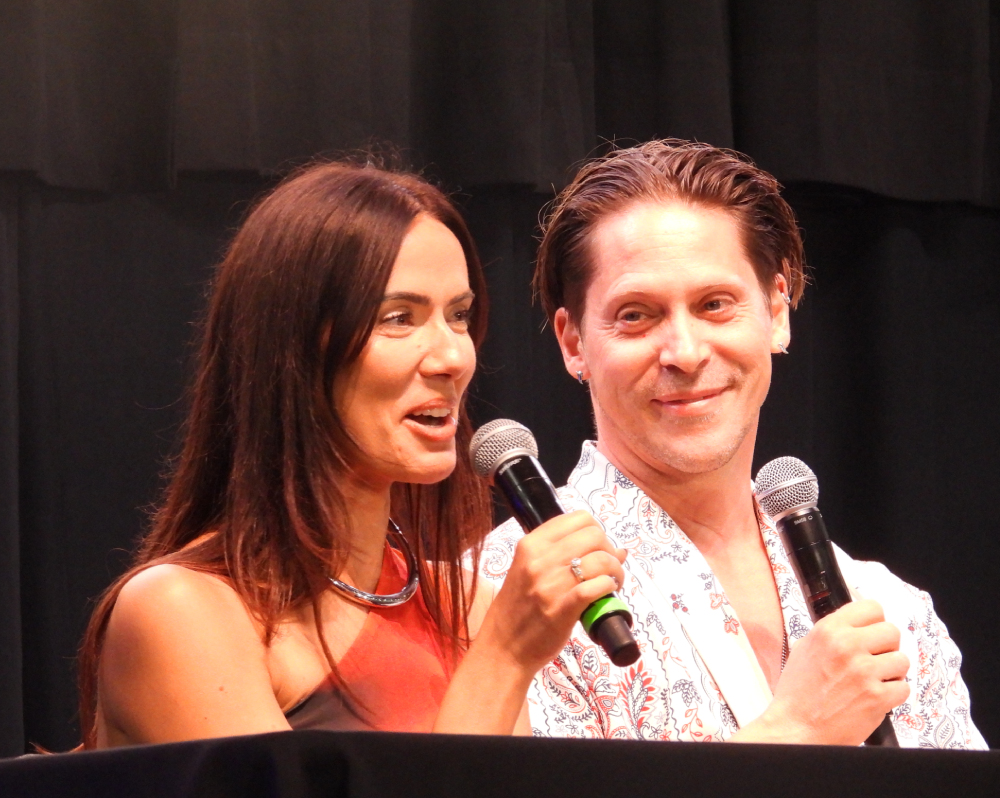
Carpenter continued, “So the setup of the show is that we are playing a D&D game live on stage, but we’ve invited the audience to play with us now. This is a theatre show; it takes place on stage. So, there are certain conventions that we have to adopt to, like it can’t be like a D&D game that you play at home that could go on for hours or weeks or years. We gotta get it done in two and a half hours.”
He added, “So, what happens at the top of the show is we let the audience choose which character our players are going to play this time. They have three choices that the audience would choose them. So, we assemble a party together every night on stage, and then they go off on a two and a half hour one-shot. Now the one-shot is always the same adventure, because it has to kind of be the same general idea, but it can go to a lot of different places. It’s a new party every night that they have to come up with the premise of what is happening, this backstory that they’re gonna go on this adventure with.”
There are 19 total character possibilities, and Carpenter asked the panel what it is like for them to step into the theatre every night and not know what character they will be playing.
“I think it’s the best part of theatre, really,” Newbon said. “Theatre is always that wonderful element of—you know, the structure of what you think you’re going to do, and it all goes to hell anyway. In the best possible way, because A, it’s improvised comedy. There is a kind of structure, obviously, that we help start at. But every night’s unique. And as Aabria said earlier, this is the one time you’ll see that particular story. And I think that’s the most exciting thing about not just theatre, but also about this show: that nobody’s ever going to see the same show twice.”
“And it goes in some really quite random directions,” continued Wilde. “It’s quite magical, actually, just thinking about the different storylines. I think as an actor, it’s like the absolute best thing you can do: to push yourself but also to have that joy. Every night is different. And I love that. And I love just being a fool on stage. My favorite thing.”
Like the roleplaying you may be used to, the dungeon master is probably the most complicated part. “[They are] the person that’s sort of keeping the story on the rails,” Iyengar said. “Though you said it’s the same adventure. If any of you have seen deeply complex flowcharts, the twine of the base story has so many permutations through it. Learning to be the DM was by far the hardest part. I’ve done a ton of improv, so getting up there and going, ‘Oh, we’re these three characters tonight. Let’s figure out a fun little throughline that feels like second nature’, but to sit there and go, ‘Based on the votes, based on what’s happening in the communication between the audience and the stage, here’s how the story is gonna go.’ It’s so granular, and it changes so much. You can go multiple nights in a row, and you will see wildly different things from the scripting, let alone what the choices you’re making on stage.”
“I also find that this particular structure and this particular amalgam of the two things of improv and Dungeons & Dragons is really freeing as an actor,” continued Bhimani. “Because, yes, you don’t know what’s happening when you get on stage, but you also don’t know what’s happening when you come in as an audience member. So you actually are getting the chance to watch your friends and appreciate their virtuosity at the same time as you’re creating something new with them. And you don’t have to memorize anything. You’re the writers’ room at the same time as you are the actors. It’s really, really freeing and empowering in that way. And some of the stories we’ve told: I’m really proud of some of the stories that we’ve told and some of the really organic moments that we’ve had that wouldn’t necessarily have happened had we not had that really wild way of putting the show together.”
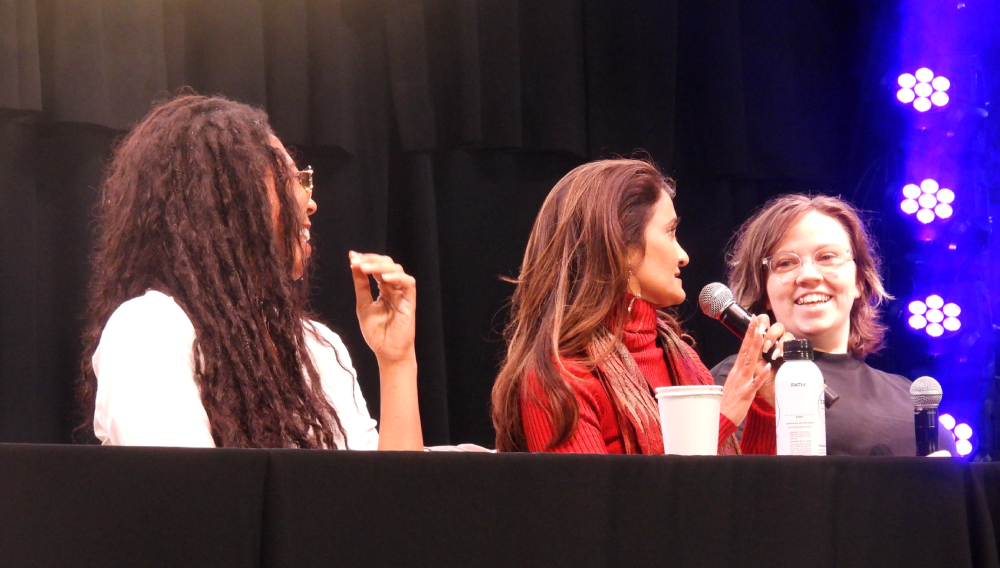
“So to be clear,” Carpenter said, “it’s a blend of scripted, long-form sketch comedy and improvisation that we put on stage together. Because the show has evolved, what we’ve discovered is that we’re somewhere in the middle between a TTRPG and an improv show. And the role, one of the things that they were referring to, is that their job is to create a story or create character arcs on stage every night. They have to come on stage, and by the end of the show, they have to wrap up in a short, brief moment—especially everybody who’s DMing—they have to bring the story home.”
Carpenter then turned the panel toward KC McGeorge, who is the set designer not only for The Twenty-Sided Tavern but also the art director for Dropout’s Dimension 20. “That definitely helped this a lot,” they said. “I try to, from the costume side, think of it from a perspective of play. I’m just giving you guys toys, really. So, with every costume, I try to think, ‘What is the one thing the actor would have a field day with?’” After the actors all talked about their favorite characters, they continued, “Then, from a set perspective, I tried to make the blocking conducive to you guys being together as a group. So previously we had the players all each have an individual little table, but we changed it to a bench so that you guys could hug or jump on it when you got a nat 20. Just trying to create an environment that supports play and improvisation so you don’t have to think about it.”
“So, when we first started talking about the show,” Carpenter added, “one of the things that KC did so brilliantly in their design was my instructions to most everybody on stage as actors. Your job is actually to create opportunity for the players, because they have to go out and create a story every night. So anything that you can do to allow them to have an opportunity to do something unexpected is going to be a successful part of the design.” The idea that it was a D&D game was inherent to both costumes and props, making sure that the items available were “what would we grab from our house?”
The Twenty-Sided Tavern has a core set of nine actors. (None of the current actors were at the panel, as they were in Chicago with the show.) Carpenter made sure to build into the show to allow guest stars to participate. Previous guests have included Felicia Day (who apparently kept trying to kill everyone), Travis McElroy, and Erika Ishii. Carpenter asked the panel what it was like working with these guests. “The entertainment industry is often built in a way that makes people feel like they are on the outside, even when they are heavily involved in the entertainment industry in any medium,” said Bhimani. “The feeling of belonging that is created by this cast for every single person who walks into the theatre—not just us as guests, but every audience member, the people out front, the ushers, everybody—they are so generous with their spirits.”
“So I worked in New York theatre for almost 25 years now,” Carpenter said, “and I’ve been a Broadway and off Broadway producer, and I left to go do this because part of what you’re hearing is, actually because of the community that I found within D&D and within gaming that I found very loving and embracing, that we wanted to be able to carry forward into the experience that we were creating, right? So, we created everyone switching around. I created a company that was based on the community that we all loved and created a sense of community. And I say, ‘This is what I want; this is who I want us to be,’ and then subsequently all of our guests have come in and said, ‘Hey, this really does feel like a sense of community here in terms of what we’re doing,’ and that is then reflected for the audience.”
During the Q&A, one of the audience members asked Carpenter what he had taken from this transition to interactive theatre. “It’s been a journey for the last roughly 10 years,” he said with a small chuckle. “There are several kinds of things that happened. I started becoming really disillusioned with Broadway because that was my career path, and that’s where I was going. Becoming a lead producer on Broadway was what I’d done for 20 years. Somewhere along the way, the magic of that like started to fade as I got deeper within the industry. I’m very fortunate as a producer that I have a bunch of skill sets in terms of business that are important when you’re building something like this. But then, outside of work, I’m a gamer, and I’ve always been a huge gamer. I love all types of games. And there was a moment when I saw the ability to put what I love, which is live theatre and live entertainment, together with gaming.”
They wrapped up with some news about the upcoming tour that’s coming to Los Angeles from November 25, 2025, to January 4, 2026, at the Montalban Theater. (Why yes, I do have tickets, and I do plan on reviewing it.)
Carpenter announced who was going to be the guest stars of the LA part of the tour: Jack Lepiarz, Neil Newbon, Erika Ishii, Aabria Iyengar, Devora Wilde, and Anjali Bhimani. Tickets for the LA version can be purchased at the Broadway in Hollywood website.
More information about The Twenty-Sided Tavern (including where it may be heading next) can be found at the official website.
See all my LA Comic Con 2025 coverage here, and see my highlight reel from the con on the Geekiary’s YouTube.

Author: Angie Fiedler Sutton
Angie Fiedler Sutton is a writer, podcaster, and all-round fangirl geek. She has been published in Den of Geek, Stage Directions, LA Weekly, The Mary Sue, and others. She also produces her own podcast, Contents May Vary, where she interviews geeky people about geeky things. You can see all her work (and social media channels) at angiefsutton.com.Help support independent journalism. Subscribe to our Patreon.
Copyright © The Geekiary
Do not copy our content in whole to other websites. If you are reading this anywhere besides TheGeekiary.com, it has been stolen.Read our
Related posts:

LA Comic Con 2024 Interview: Composer Darren Fung

Tom Prior and Peeter Rebane's Film "Firebird" is Too Good to be True
Midsummer Scream 2024 Interview: Zombie Joe of Zombie Joe's Underground Theatre

From Wattpad to Film: An Interview with Kate Marchant, Author of "Float"

LA Comic Con 2024 interview: Only Murders in the Building's Shelly Westerman and Payton Koch

LA Comic Con 2025: Sean Abley and the Appeal of Queer Horror