WonderCon 2025 Interview: Andy Nordvall, Kaj Kunstmann, and Bad Future Vol. 1
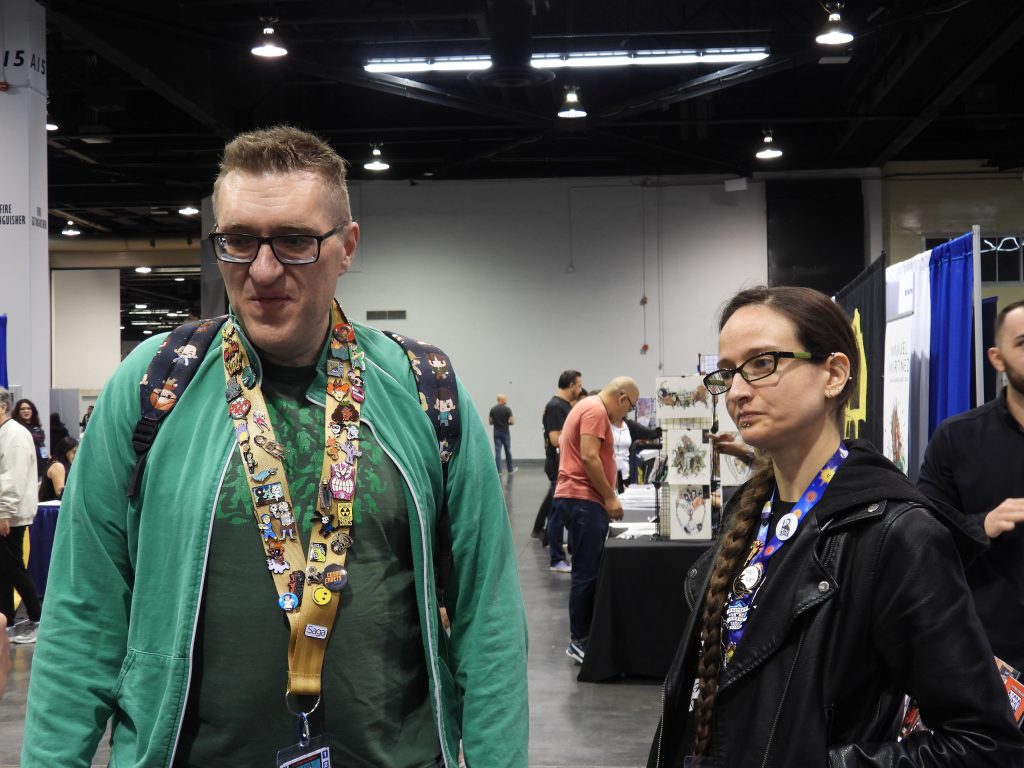
Andy Nordvall understands that crowdfunding an anthology comic that is dystopian science fiction might be an odd choice in today’s political environment. “It’s funny you mentioned that, because it was less relevant when we started,” he said with a laugh. “There was this moment of like, ‘Should we do this?’ People can just open up a news thing.”
Nordvall is a writer of comics, novels, and screenplays. He’s also the organizer behind the Kickstarter for Bad Future, Volume One: A Comic Anthology of Dark Sci-Fi. So what made him commit to the project? “Because I’ve noticed there’s been a huge spike in sales of dystopian fiction. And I think even though dystopian fiction is bleak, it’s all about carving a space where you can find hope, where you can have agency even under dire circumstances. And I wish that weren’t quite so relevant, but it is.”
I had a chance to interview him and one of the contributors of the project, Kaj Kunstmann.
I asked Nordvall what inspired the idea of doing the anthology in the first place. “I love the idea of Kickstarter and starting small,” he said. “I actually went to film school as a screenwriter. There’s a lot of us out there, and it’s very frustrating. Needing, in a weird way—needing permission or having to raise the money yourself and just trying everything for a while. Do the thing you can do now, and this is what I can do now. But I also said, ‘Well, it’s my first one, so maybe don’t do it alone.’ And that’s why I started asking my friends and other writer artists I admire [to] jump on board.”
I asked how he decided on the contributors. “It was a very selective criteria of people who said yes,” he said with a laugh. “It was just people I met at cons. And that’s how it works.”
We then talked about the stories that are in this first volume. “Mine is called ‘Soulless’,” Nordvall said. “It’s about a guy who’s a cop basically policing genetic monopolies that have created a second Gilded Age where the elites are now smarter, younger, and better looking than the rest of us who are just scrounging, trying to survive.
“And it is very much that noir hero like Sam Spade or Jake Gittes: the morally compromised hero who is starting to realize just how much he’s compromised and wondering if maybe just deep down there might be some moral center to him. And he’s also getting older in a world where you’re not allowed to get older. Nothing autobiographical about that at all living in Los Angeles,” he said with a laugh.
“My story is called, ‘The Contract’,” Kunstmann added. “It is set in a world where technology has advanced such that human consciousnesses can be uploaded post-mortem to servers. The idea was it creates this utopia where everyone’s equal. There’s no need for money, because we’re all digital.
“AI can provide all of these—anything you want, anything you need, AI can do it. But this is like 70 years after that advent where [it] didn’t really change anything, because the wealthy can upload to really nice servers, and the poor and the felons are left to scrounge on sh**ty servers.
“It’s about an archivist who kind of trades in human memory. It’s not really a currency, but it’s a high-value item: where AI can’t generate how fabric feels against your skin; AI can’t generate how baked cookies smell or what it feels like to be in love. So these files, or these simulacra, are still high-value items that people can trade, and the main character trades in these items. When a client comes in to trade some of these simulacra, upon viewing she realizes that one of the people in these memories was at her and her wife’s wedding.
“So she’s like, ‘My wife never got uploaded even though we were supposed to upload together. Maybe you can help me find my wife.’ And she’s like, ‘Well, this person has gone missing as well. So, if you can help me find my girlfriend who’s missing, I’ll help you find your wife who’s missing.’ And that’s the plot: them trying to figure out what happened to these two consciousnesses that were either supposed to upload that didn’t, or that are now sort of spirited away in the digital ether.”
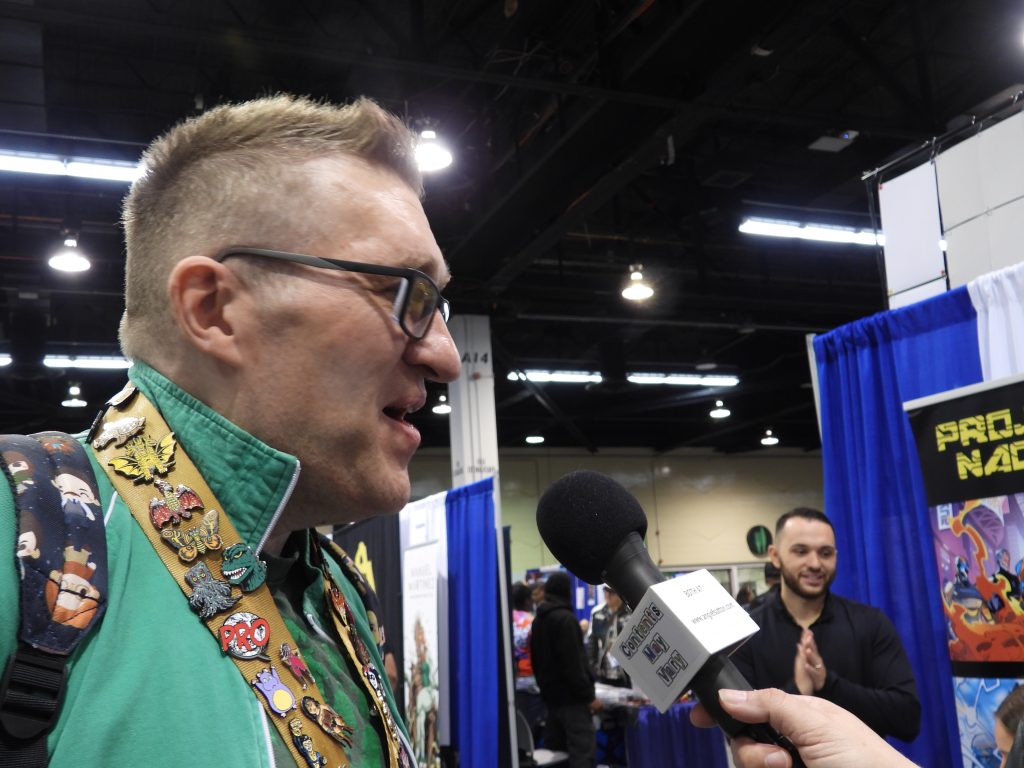
The book is labeled as ‘Volume 1’, so I of course had to ask Nordvall about his plans for Volume 2. “Let me finish one,” he said with a laugh. “A lot of it depends on printing. It can take six weeks to print, but I’ve heard so many horror stories of the first time they print. So, a lot of it is going to depend on the universe, as is often the case. But I would love to do a Volume 2. I call it Volume 1 very consciously.”
“Mine does not conclude in 16 pages,” Kunstmann added. “Mine is probably going to be like 100 pages, because I’m a slow burn kind of writer. So, I’m with you, Andy. Don’t abandon me.”
One of the aspects of Kickstarter, of course, is the rewards associated with different levels of donation. I asked Nordvall what his favorite reward was. “Well, I’m waiting for some of the covers to come in,” he started. “Everybody who contributes is going to have their own variant cover. This is the first Kickstarter, so we’re going to keep the rewards pretty simple. It’s going to be the book with some variant covers. We’ll probably put maybe some art prints and stickers, but I don’t want to make people pay for that. I love it when you get the Kickstarter and there’s a few extra goodies in there. So, my favorite reward will be the surprises that will be in the books.”
When talking to creatives, as a creative myself, I’m always curious as to what they do to keep from getting burned out, to keep the creative process fresh. “I’m very lucky that I have some work that gives me a lot of downtime,” Nordvall said. “I feel I’m just owning my privilege. I was able to get a position that gives me the downtime to create. But also, I don’t know–if you love doing it, you love doing it. The thing I learned is, if you ever feel blocked, just write about why you’re blocked and you will figure out why you’re blocked and get unblocked. You just gotta type or write or draw.”
“This is going to sound really not easy to do, but stress less,” Kunstmann added. “Take a step back; don’t force it. Go do something else. Do something with your hands, especially because a lot of our way of writing these days is like typing. I used to write longhand until I gave myself carpal tunnel. Go get outside. Put it away. Don’t look at it, whatever it is. At least for me, it’s the same with writing as it is with art. Try not approaching it directly.
“I usually find that my breakthroughs are when I’m not thinking about it actively, when I’m thinking on something else, that’s when the second half of my brain, like the back boiler plate, is like tinkering with it. But I’m not trying to force it out, you know? It’s trying to just charge down a wall. Writer’s block is just going to make you sad and make you think that you’re not good enough. Don’t be hard on yourself. Society is already hard on us enough, you know? You’re not going to help.
“And I know that it sounds hard and it’s going to sound really like hippie of me to say this, but I recommend meditation. Just focusing on your breath, not thinking about anything, letting your mind go to something else, and it will naturally find its way through with a little bit of teasing.”
Part of Nordvall’s background is that he’s a member of the Society of Children’s Book Writers and Illustrators. I asked how it was different writing for kids than for a more general audience. “It’s like half of me is writing as a dad, but half of me is also trying to remember the kid,” he said. “You think you’re in touch with it. I think if you’re a creative person, that will always be a little thread connecting you to kid you. But just sort of remembering who you are as a kid is a weird muscle, and it’s one I’m still kind of training.”
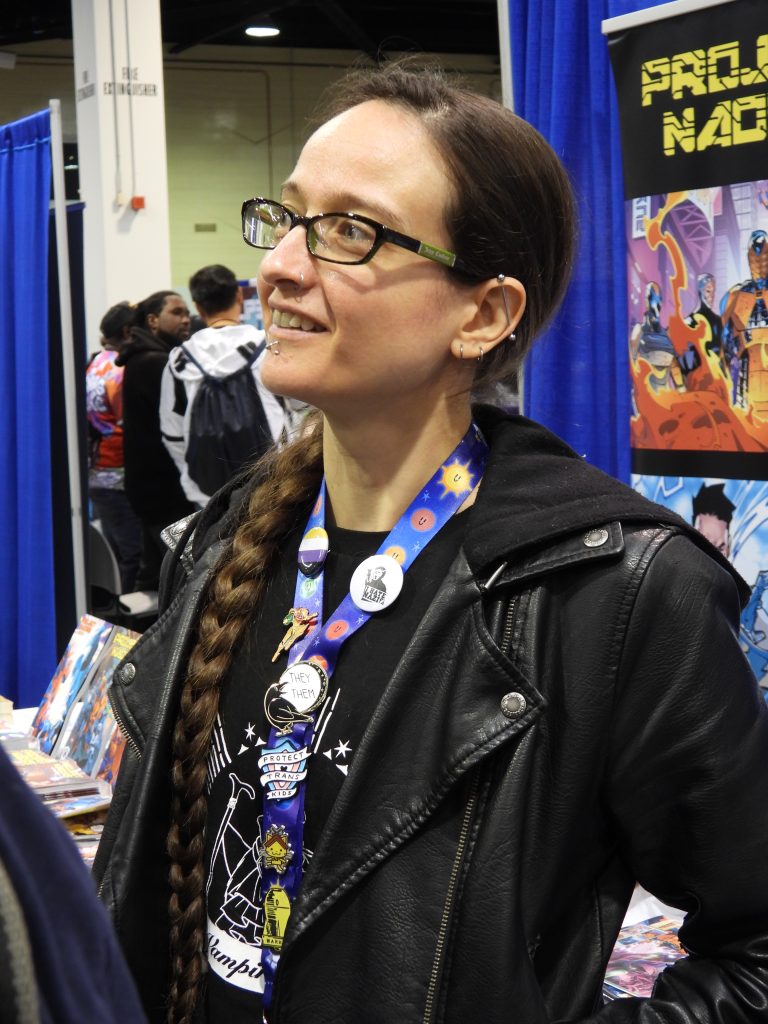
I asked Kuntsmann why they were an artist, especially in today’s world. “I think that it’s really prescient to find some way as a human being to express yourself and find joy in being alive, I think it’s important as a vehicle to connect with other people and to facilitate your own mental health. If you’re not trying to express something from within yourself or connect to other people, I don’t see the point in doing art. Being an artist is definitely hard, but I think enjoying the process of making art is really important, and that’s this constant relearning of how to not rush yourself and really settle into—even the most mundane of details, you can find joy.”
Kunstmann not only is an artist: they have their own publishing imprint. I asked them about what that was like in the current cultural landscape. “I started off printing my own stuff in 2013. It just didn’t really make sense to change that,” they said. “I like having control. Not that I don’t need an editor: I do always need a second pair of eyes on my work, because objectivity can be a struggle when you’re making your own stuff and printing your own stuff. But I wanted to be able to try new ideas when they felt good and not wait for somebody to give me permission.
“If I want to make little cat stickers, I’ll make little cat stickers. And then on collaborative projects that I do myself, I want to make sure that I pay people well. Because as an independent artist who worked for writers for 10 years, I can say that while it did help me, I also did not make a living wage for like seven years, which is another reason why I’ve kind of leaned in more to doing my own stuff.”
They went on to talk about their spouse, who they met at Comic-Con in 2019 and is also interested in comics. “Having another person to sort of siphon energy and enthusiasm and spirit into that, it really helps to make it feel like a community and less like a job,” they continued. “It’s about, for me, community and the freedom to express myself. And that sort of camaraderie is what I feel like keeps the comics community alive on this level.”
One of Kunstmann’s projects listed on their website is that they’ve designed their own tarot deck. My wife, who was there taking photos, does tarot as well, and so asked about how they came up with the theme of the deck. “I’ve been pagan since I was like 12,” they said. “I converted to paganism, and that was when I started getting into tarot and being aware of it and its uses as a tool.
“So for me, once I had that idea, I was like, ‘Maybe I’ll try doing a tarot deck with it,’ because Adam does go along a journey in Warhead, and it is about self acceptance and self confrontation and making yourself better and how hard that struggle against mental health is. I started making Warhead before I knew that I had borderline personality disorder, anxiety, and depression, and then about issue four: that’s when I got diagnosed. And I was like, ‘Oh: so this has just been an unintentional journal about my experience of self confrontation.’ And that’s exactly what Warhead is, and it is, in a way, what the tarot is.”
Part of Kuntsmann’s artist statement states that one of their goals is to express their nonbinary and queer identity. As such, I asked how they go about doing that: especially considering what’s been going on in the world. “Most of my work involves queer identity in some way or another,” they said. “My project Warhead that I started in 2013 and finished in 2024 has a queer and trans couple. One of the characters is shamelessly a self-insert of myself when I presented as female and didn’t know that nonbinary identity was a thing. And then I had them transition to being nonbinary as I went along that journey myself and had them come out in the third volume. It’s something that I feel has a lot of room for creative exploration of experience and the human condition.”
They smile a bit grimly and add, “Not gonna lie: I’m a little bit scared. But I feel under these circumstances especially, it’s all the more reason to be more loud.”
The Kickstarter hasn’t been launched yet, but you can find out more about it—and sign up to be notified when it’s launched—here. You can find out more about Andy Nordvall here, and see Kaj Kunstmann’s Instagram here. See all my WonderCon 2025 coverage here.

Author: Angie Fiedler Sutton
Angie Fiedler Sutton is a writer, podcaster, and all-round fangirl geek. She has been published in Den of Geek, Stage Directions, LA Weekly, The Mary Sue, and others.
She also produces her own podcast, Contents May Vary, where she interviews geeky people about geeky things. You can see all her work (and social media channels) at angiefsutton.com.
Help support independent journalism. Subscribe to our Patreon.
Copyright © The Geekiary
Do not copy our content in whole to other websites. If you are reading this anywhere besides TheGeekiary.com, it has been stolen.Read our
Related posts:
"Teleport" to a Better Future
Hybrid RPG & Visual Novel Title "Ignis Universia" Launches Kickstarter Campaign!
Wandering Planet Toys Launches Kickstarter For Officially Licensed "Nancy Drew" Action Figures!
Donuts, Violins, and the Queer Experience: "Light from Uncommon Stars" Book Review
Futurama 11x06 & 11x07 Review: 'I Know What You Did Last XMas' & 'Rage Against the Vaccine'

WonderCon 2025 Interview: Legion M’s "Fade to Black"