
A “Roguelike Action RPG Co-op” with Magical Girls: An Interview with Akira Sipes
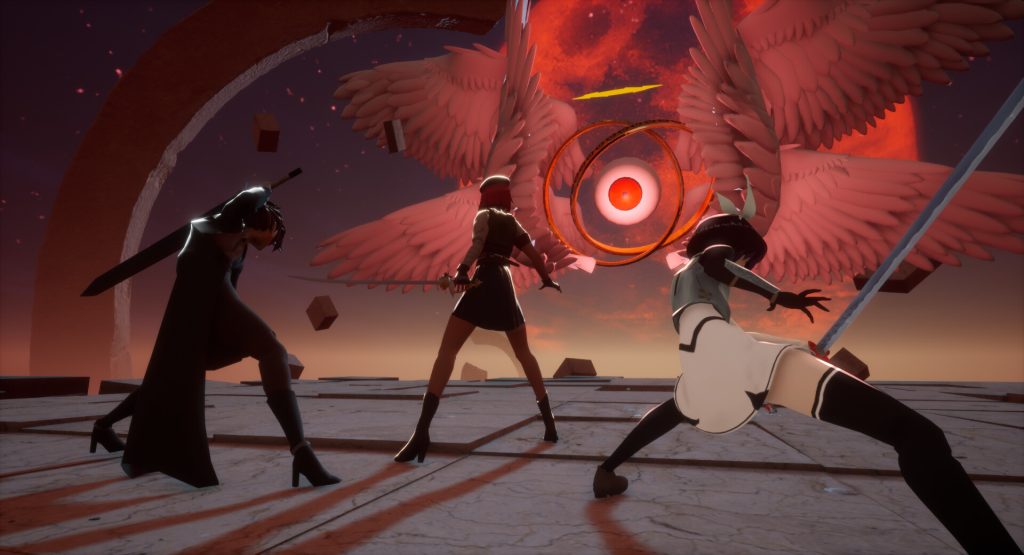
Among the many games submitted to Indie Dev Argentina, there was a striking anime-inspired action RPG that held a lot of my attention.
It looks great, of course, but it also plays like butter. It’s a love letter to a genre, but it’s also the product of people who understand it deeply.
I couldn’t resist the chance of getting to ask Kernel Hearts‘ director, who goes by Akira Sipes, about their game. You might remember him as the guy wearing a mask in the highlighted image from a previous IDA article.
He used the mask on stage and everything!
Akira is the founder of Epehemera Games, a new game studio born in Argentina with a deep passion for anime games:
“That’s not a decision we took. It’s a decision that took us, for who we are as people and part of the studio. We can’t do any other type of game. We’re all otakus to death, basically. I know it’s a word that might have different connotations. But we at least are talking about the 2010s.
“I met various people who are now in the team in 2010, on a Skype group centered around Touhou, Touhou Project. We’re friends to this day. And the person responsible for the visual department of the game, Huffie, the art director, also has an adolescence, an infancy, and a life marked by anime and Japanese aesthetics.”
“Beyond anime, which we consumed infinitely thanks to old Animax, we got a lot of influence from JRPGs. A lot of big titles, mostly titles from the PlayStation 2 era. Those games were very easily accessible in Latin America at a certain time. Titles that defined eras.
“And then much more recently, modern things, like Nier Automata, Genshin Impact, and the new games from Shin Megami Tensei and such. They helped tremendously in forging the game’s aesthetic.
“Much more recently, the new Persona 3 Reloaded. Persona 3 is the main game from which we took inspiration, both on the aesthetic side and the thematic side. But then Reloaded took a new visual imprint and readapted it to consoles and modern resolutions. It’s impressive, the use of lights.
“We work rimlights very similarly, and a lot of aesthetic details we take from there.”
Taking so much inspiration from Japanese games might sound intuitive, but it’s actually a really complicated ordeal in practice.
“When you want to make an aesthetic (…) much more inspired by Japanese games, the amount of resources you have as a developer is much more limited, or exists only in Japanese.”
“So we have to do a lot of reverse engineering. Like, okay, this is how Guilty Gear solved it, this is how Automata solved it. This is how Genshin Impact solved it. (…) That’s what we do to give the game its visual imprint.”
Despite the grandiose vision for the game and the striking aesthetics, Ephemera’s origin is quite humble.
“Ephemera actually started with a desire I had to make a game. I always wanted to do that. I tried to get into the Argentine games industry— it isn’t the biggest in Latin America. You have a lot of limitations.
“I wanted to enter the industry as a programmer, and I was a very bad programmer. I didn’t stand a chance. Then, well, I had to find another job, but the spark never went away.
“Some years later, during the quarantine, I started working three jobs at the same time to be able to save money, because I knew that I wanted to make a game. But because I was very bad at programming and I knew I didn’t have the discipline to make it all by myself, I knew I wanted to have a team.
“So I saved from 2020 through 2022. Two years working three jobs at the same time. And with that budget, I started Ephemera Games, and called up all these friends I’ve known for a while. They didn’t have experience as game devs, but that’s what I could afford.
“And Huffie, who’s the art director. She hasn’t made a game before either, but she has a lot of experience in the 2D animation industry. And with that, we began, the four, the Studio. We did a prototype for Kernel Hearts. It was originally called Mahou, which was a very different name.
“Then I found out that a Spanish beer had the same name, and we wouldn’t have discoverability if we chose that. That’s how we started at Ephemera. With that prototype, we went out looking for funding, and in around seven months, we found a publisher that decided to contribute the funding needed to make a complete game.”
It’s quite the underdog story! Three jobs for two years just to get a shot to make your game is a very intensive regimen. Seems to have paid off, but Akira was quick to tell me…
“I would not recommend it to absolutely [anybody].”
From there, we got into the game proper. What is Kernel Hearts, and what inspired it?
“Kernel Hearts is a very peculiar game. It’s a roguelike action RPG multiplayer co-op. That’s a lot of words, but I think they all make sense together. (…) It’s inspired by games like Nier Automata, Devil May Cry, and character action games. You have combos, you can juggle enemies in the air, and you can combine different kinds of actions to make your character do different things.
“It’s a game where you and the other three magical girls have to traverse the tower of babel to defeat God, as many JRPGs do. You do that to save the world from the ashes. In Kernel Hearts‘ world, the last of civilization is living around the tower of babel. The rest was completely buried in ashes.
“The tower burns the memories of humanity to create these ashes that fill the world and, on top of that, erases the memory of the people that live near it. The people are constantly forgetting things and losing their memories.
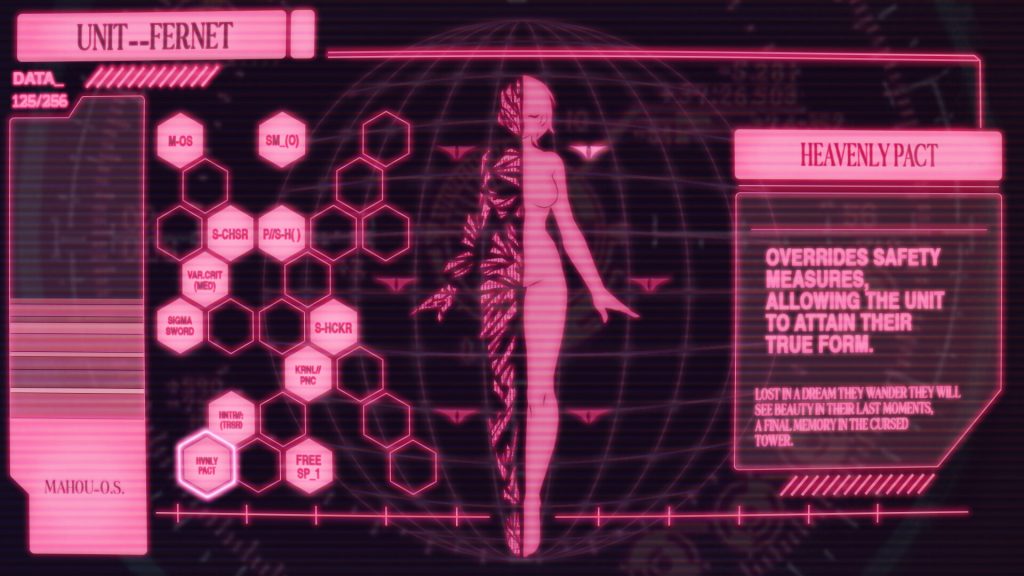
“You are part of the Mahou unit, that are a group of magical android girls based on the backup data from previous magical girls from past history. You’re going to ascend the tower of babel to try and stop the curse. Each time you die, you return to a previous backup, and that’s how the roguelike loop emerges.”
The ambition is evident in such a description. It’s clear that it isn’t a small game, and as such, it’s a big undertaking from a very new studio. I was even more surprised to know that the idea had actually been scaled down.
“The original design, actually, now there are seven floors, something like that. In the original design, the tower of babel, I imagined that it had like 100, 200, 500 floors, something like that.
“The floors randomly change, and you have to keep moving upwards. You and your friends go 10 floors at a time and ascend the tower piece by piece, let’s say, and you can always go back to a certain point.
“When we realized that it was absolutely impossible to make a hundred floors, we had to change perspective. That’s also because at first the game was room-based (…) where you fight in a closed room.
“We realized that it didn’t mesh very well with our combat and decided to try with an open world (…), and we discovered that the pacing is much more interesting when it comes to confronting the level. You’re constantly moving, enjoying, (…) the character moves extremely quickly, we wanted to make a game that goes at full speed, that it’s quick, fun, constantly going from one fight to another.”
I can confirm that the game is really fast-paced and very enjoyable to move around in. The open spaces benefit the controls immensely, and I can’t even fathom how a more enclosed location would function with such fluid movements.
But how does a game of Kernel Hearts work in practice?
“The usual game loop is that the players get together, they get a chance to talk with the town NPCs, and keep up-to-date with their stories. Each time you return to the town, you have new things to talk about.
“You can overcome things, buy new models of Magical Guards (…) and progress systems they have like chips and then progress the story of some of the town characters, which generally give you a reward once you finish it.”

“Once you enter the tower of babel, there are approximately seven or eight floors that you have to move through. After two floors, there usually is an NPC level, a safe place where you can use your resources, listen to NPCs that live inside the tower, where they don’t lose their memories.
“Their motives are very different from those of people from outside. It’s a way to get to know the inhabitants and natives from the tower and discover why the tower is there and what happened. You start piecing the story together.
“And well, you keep playing with your friends. While the host reads the visual novel part, there is a play where your friends can practice combos and such.
“While the levels progress, the players start finding coffins, which are the remains of previous magical girls that entered the tower. When you open a coffin, a purification starts, that is a moment where you fight against a bunch of angels at the same time.
“If you win, you can obtain the power of a magical girl that was previously at the tower, like a perk or power-up in so many other roguelikes. You start collecting other people’s powers and making your arsenal, and build, which changes how you play each time.
“Each NPC you find along the way can also give you a quest, called a promise. Once you complete a promise, you get a reward. You only get one per playthrough, so you need to choose which one you’ll take carefully.
“That way, you start putting together your build, your character, but overall, you learn how to play. You aren’t going to win on the first try, and then you go back to the beginning and try to learn from your mistakes.”
That’s a pretty intense game loop! Full of choices and memorable moments. I commented to Akira that it’s a very striking number of elements.
“The idea is that they won’t appear all at the same time, but rather that you go about mastering a system at a time. (…) The most important part is the info the player acquires as the game progresses. How to execute attacks, how to make good choices. (…) Those are for us maybe the most interesting and fun parts, where our design is focused.
“And also, yes. It’s a very complex game, and Ephemera is a very small studio. We sometimes have to pick our fights, but we try to create the game we always wanted to make. So we get a bit carried away and then have to find how to make it make sense with the resources we have.”
I couldn’t really resist asking about it. Why magical girls?
“That’s a good question. I think magical girls is a quick way of defining the concept. Kernel Hearts doesn’t look so much like Japanese mahou shoujo in many regards.
“Some people compared us with Madoka, with maybe being an anti-trope or whatever. I never saw it that way, I don’t want to make a subversion (…).
“I always liked the theme; in fact, we made a game for a Magical Girl jam where I wrote the script. It was very different from what Kernel Hearts is now, but it has a similar base, and I really liked the worldbuilding. Also, our artists are pretty good at drawing anime girls, and we couldn’t let their talents go to waste.”
I actually played Duvet out of curiosity and in preparation for the interview. It’s a short narrative adventure with PSX survival horror aesthetics and tank controls. It’s compelling and weird, and the story is pretty good.
The game came before Ephemera, however. It was just a project between a group of friends. The seeds of Kernel Hearts, however, are very clearly nascent in Duvet.
“It was a game where we wanted to try narrative stuff, different stuff. (…) The foundations of worldbuilding were born there. It later became the foundation for Kernel Hearts‘ worldbuilding.
“As a fun aside, the musician who made Duvet‘s music is now the main programmer for Kernel Hearts. He did a very big change of roles.”
Funnily enough, Akira doesn’t really remember clearly which idea came first.
“I honestly don’t remember. I think it was the jam, mainly. I said, Okay, what’s an interesting story about magical girls? I always liked the Metal Gear Solid series. And a thing that it does, that we have a lot of references for that in Argentina, is a sort of non-fiction. Talking about real events through fictitious means. Using fictitious elements to talk about real stuff.
“We (…) wanted to do something similar. Take the concept of a Cold War where the Russians win the space race and, unknowingly, take a pregnant woman to the moon. That woman, exposed to lunar material, gives birth to the first magical girl.
“That produces an arms race of sorts to create magical girls all across the world, which extended the Cold War for many years, past the 21st Century. That ends up causing a nuclear war that gave rise to the tower of babel.
“That’s a bit of the setting, let’s say, of Kernel Hearts, that was a bit similar on Duvet, but I decided to adapt it to be something different.”
Given that Kernel Hearts won Best Gameplay at the IDA awards, I was keen to know about Akira’s favorite game designers.
“Hideo Kojima, Yoko Taro… for sure. (…) Keita Takahashi, the designer for Katamari. Also, Yukio Futatsuhi, the designer of the Panzer Dragoon series, and more importantly, Phantom Dust, is a great game. I really recommend Phantom Dust.
“And also… Kazunari Yonemitsu, who is the designer and director of Baroque, is the designer and director of Baroque, which is a game that inspired Kernel Hearts a lot. It’s a game originally for Sega Saturn (…) and then for PlayStation 1, all Japanese only.
“Then two or three years ago, the first patch in Spanish, and then an English patch, where you can enjoy the game now. It’s a roguelike for PlayStation 1. It’s fantastic because it’s one of the first games where, at least that I know, the story happens when you lose, not when you win.”
I told Akira that I will certainly play Baroque now, and he welcomed me to the fifteen-person group of people who have played the game. Well, they’ll be sixteen with me!
Closing out, I asked Akira about the future of Kernel Hearts. What can we expect?
“Development is at full force. We will announce a new playtest soon. If anyone’s interested, the best place to find news is our Discord. We also have a channel where we, the devs, are constantly answering questions. We love talking with you guys.
“We’re all always around the server, even in Voice Chat sometimes. So we’ll be waiting for you there.”
Kernel Hearts shows a lot of promise. When the playtest comes, I will be sure to share my opinions with you. For now, thanks, Akira, for your time!
- Wishlist Kernel Hearts‘ on its Steam store page.
- Check Ephemera Games’ Discord Server.
- See more of our game’s coverage.

Author: Claribel M
Writer, narrative designer, journalist. Perpetually doing too much.Help support independent journalism. Subscribe to our Patreon.
Copyright © The Geekiary
Do not copy our content in whole to other websites. If you are reading this anywhere besides TheGeekiary.com, it has been stolen.Read our
Related posts:

Open-World Cozy Adventure Game "Petit Island" Released on Steam, Nintendo Switch and More!
"Unsorted Horror" Delivers Bite-Sized Dread - Game Recommendation
Latin Cowboy Farming Adventure Game "Gaucho and the Grassland" Gets Steam Release!
"Aequor" Game Recommendation — deep sea misadventure

Adorable Cloud Farm Indie Game "Clouzy!" Gets July Steam Release
Black Tabby Games Comes Back Home with Scarlet Hollow's "Roads Untraveled" Update